

These are solid pieces of art, sculptures created by a 3-D printer. However, when you spin them under a strobe light (or in this case, set the camera to take a series of delayed exposures), you see something entirely different. The sculptures look alive.
Standord professor John Edmark used the precise mathematical formulation of the Fibonacci sequence to design these. The well-known sequence is constructed by starting at one, then adding the previous two numbers to create the next number. The result in the first two numbers being 1, but then expands at a logarithmic rate from there (i.e. 1, 1, 2, 3, 5, 8, 13, 21, 34, 55, 89, etc.).
This sequence, found in abundance in nature, is often curved around on itself to form the shapes of shells or spiral galaxies.
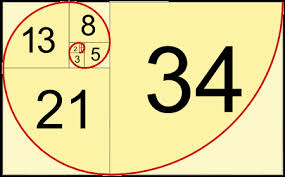
The Fibonacci spiral, which is used to explain natural shape of the smallest shells in the ocean, to the largest of spiral galaxies. (Image from mathisfun.com)
The results, as you can see, are mesmerizing.